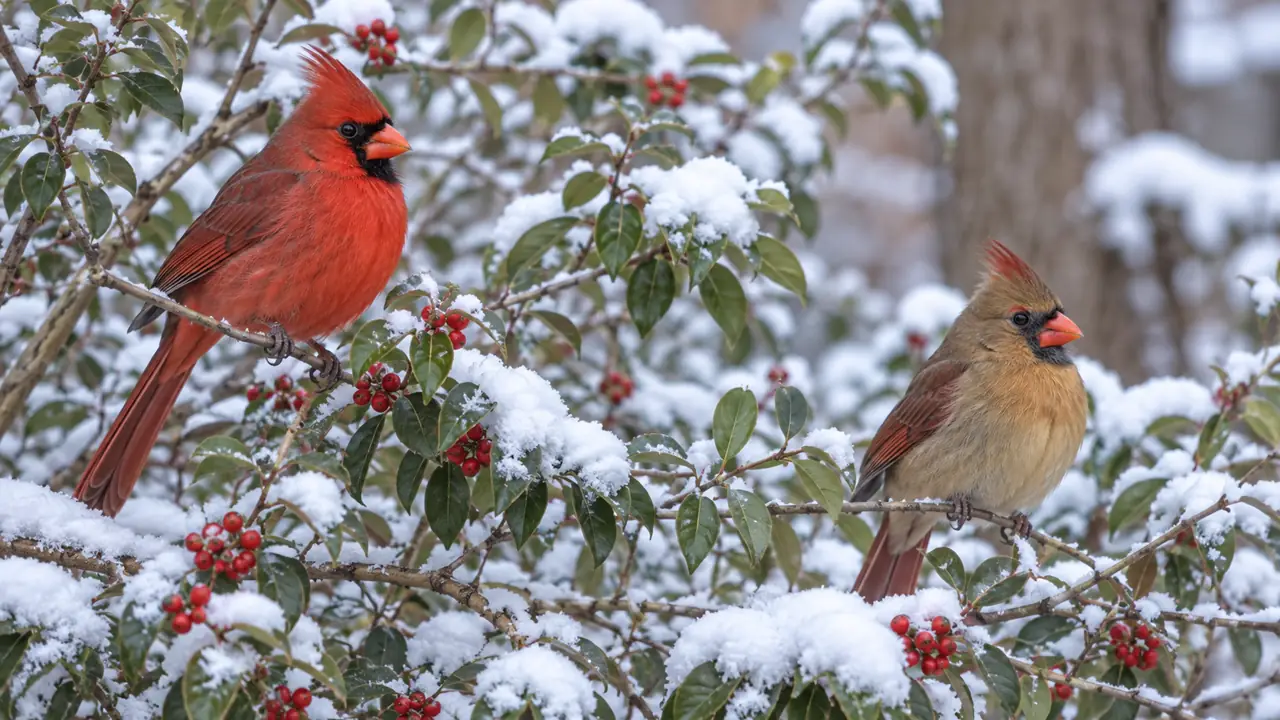
Quick answer
Northern Cardinals do not make a regular seasonal migration between separate breeding and winter ranges. Cornell classifies them as residents. The birds still move locally to food and shelter, gather in winter flocks, and young birds disperse from natal areas. Those movements—and the species' gradual range expansion—are not the same as annual migration.
In this guide
- Scope: Northern Cardinal, not every cardinal-family bird
- Resident does not mean motionless
- What cardinals do in winter
- Why a familiar pair may seem to vanish
- Juvenile dispersal is not migration
- Range expansion is a population change
- Does cold weather make cardinals leave?
- How to support resident cardinals
- How to verify seasonal movement locally
- Bottom line
- Sources and verification
No. Northern Cardinals do not migrate south for winter. Cornell classifies them as residents, so their breeding and winter ranges broadly overlap and individuals normally remain within the year-round range.
They are not stationary. Cardinals move between food patches and shelter, form larger groups in fall and winter, and young birds disperse from where they were raised. Those are real movements, but they are not the same as an annual north-south migration.
Scope: Northern Cardinal, not every cardinal-family bird
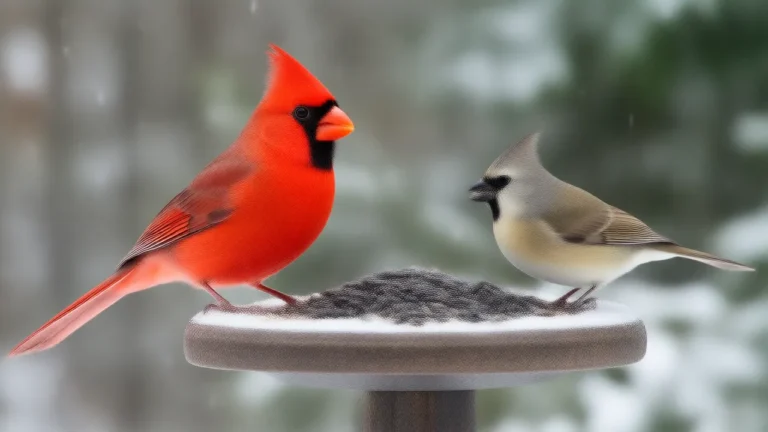
In everyday U.S. birding, “cardinal” usually means Northern Cardinal. That is the red-and-brown crested species common across much of eastern and central North America and parts of the Southwest.
The family Cardinalidae also includes grosbeaks, buntings and tanagers with different movement strategies. The simple resident answer applies to the Northern Cardinal, not automatically to every species in the family.
Resident does not mean motionless
| Movement | What it looks like | Is it migration? |
|---|---|---|
| Daily foraging | Short trips among thickets, seed patches and feeders | No |
| Winter flocking | Pairs and neighbors gather in a larger feeding group | No |
| Weather response | Birds spend more time in dense cover or sheltered food sites | No |
| Juvenile dispersal | A young bird leaves the natal area and settles elsewhere | No |
| Range expansion | The population occupies new areas over years or generations | No |
| Seasonal migration | Regular movement between distinct breeding and nonbreeding ranges | Northern Cardinals do not normally do this |
Cornell's migration guide defines permanent residents as birds that do not migrate, while recognizing other patterns such as short-distance, partial and irruptive migration. The Northern Cardinal's species map explicitly gives it resident status.
What cardinals do in winter
During the breeding season, Northern Cardinals commonly move in pairs and defend territories. Cornell reports that in fall and winter they can form flocks ranging from roughly a dozen to several dozen birds and may forage with juncos, sparrows, titmice and finches.
A winter flock can make a yard seem suddenly full of cardinals, then empty when the group moves to another food patch. That is local foraging behavior, not a departure to a distant winter range.
Dense shrubs, hedgerows and woodland edges provide shelter. Seeds and fruit remain important foods, and black-oil sunflower is a familiar feeder choice. The guide to winter bird food explains how to supplement natural food without treating a feeder as the birds' only resource.
Why a familiar pair may seem to vanish
A temporary gap in feeder footage is not proof of migration. Check local causes first:
- native berries or seed crops may be abundant elsewhere;
- a winter flock may be using a different circuit;
- a hawk, cat or repeated disturbance may have changed the approach;
- wet, stale or newly changed food may be less attractive;
- vegetation may hide visits that were obvious in another season;
- territorial behavior and pair routines change across the year.
Review several days of footage, including dawn and late afternoon. The site's cardinal camera guide covers the viewing angles and times that make quiet visits easier to detect.
Juvenile dispersal is not migration
Young cardinals eventually leave their natal area. A radio-telemetry study in a central Ohio landscape documented juvenile Northern Cardinals dispersing locally within forest fragments or making longer movements through the surrounding landscape.
That study describes post-fledging dispersal: a young bird moving away from where it was raised. It is not a recurring seasonal commute, and the study's timing and distances should not be applied to every population.
A young cardinal can also be mistaken for an adult female because both are brownish. The guide to male versus female cardinals explains adult plumage; juveniles are distinguished in part by a dark bill before the adult orange-red color develops.
Range expansion is a population change
Northern Cardinals have expanded northward over the last two centuries. Cornell associates their success with the spread of towns, suburbs and shrubby edge habitat. A range map can therefore change over decades even though individual cardinals remain residents.
Range expansion occurs as birds survive, disperse and breed beyond a former boundary over many years. Migration is a repeatable seasonal movement. Confusing the two makes a resident species appear migratory merely because its overall distribution is changing.
Does cold weather make cardinals leave?
Cold alone does not turn Northern Cardinals into migrants. Cornell's migration overview explains that birds commonly migrate to reach seasonal resources, not simply to avoid a temperature. Resident species meet winter through behavior, physiology, shelter and available food.
A storm can produce short local movements. Cardinals may concentrate in protected thickets, visit a reliable feeder more heavily, or disappear behind cover. When conditions improve, their routine can change again.
The University of Minnesota cardinal guide describes the species as nonmigratory and adapted to Minnesota winters. Seeing a cardinal throughout the year does not prove that an unmarked bird is the same individual filmed in summer.
How to support resident cardinals
Build habitat that works in every season: dense native shrubs for cover and nesting, fruiting plants, seed-producing grasses and a clean water source. Keep cats indoors and make windows safer.
If you feed, use a stable tray or hopper suitable for a cardinal's size, keep seed dry and clean the station. The guide to attracting cardinals combines sunflower, safflower, cover and water without relying on one food.
How to verify seasonal movement locally
Use the Cornell range map for species status, then compare recent eBird records or weekly abundance products for the local area. A resident species may be recorded more often in one season because foliage, singing, flock size and observer effort change detectability.
BirdCast radar is designed for broad migration traffic and will not tell you whether one cardinal pair left a yard. The guide to tracking migration explains what radar can and cannot show.
Bottom line
Northern Cardinals are year-round residents, not regular seasonal migrants. They still move: winter flocks shift among food sources, pairs change routines, weather alters cover use and juveniles disperse. Treat a temporary feeder absence as a local observation problem first, not evidence that the cardinals flew south.
Sources and verification
- Cornell Lab: Northern Cardinal range map — resident status and year-round range.
- Cornell Lab: Northern Cardinal life history — winter flocking, habitat, diet and pair behavior.
- Cornell Lab: bird migration basics — resident, short-distance, partial and irruptive movement definitions.
- Ornithological Applications: post-fledging dispersal study — juvenile Northern Cardinal movement in one central Ohio landscape.
Questions people ask
Where do cardinals go in winter?
Northern Cardinals generally remain within their year-round range. They may use different thickets, food patches and flocking sites than they used during the breeding season.
Why did my cardinals disappear from the feeder?
Natural food, flock movement, predators, disturbance or a change in the feeder can shift local visits. A temporary absence does not mean the birds migrated south.
Do male and female cardinals migrate differently?
Neither sex makes a regular seasonal migration. Pairs often move together during breeding, while fall and winter can bring looser flocks and changing social groups.
Is range expansion a type of migration?
No. Range expansion is a population establishing farther into new areas over years or generations; migration is a recurring seasonal movement by individuals or populations.
Written by the Backyard Birdcam team with AI assistance. Found something we got wrong? Email shop@smarternewsnow.com and we will fix it. How we write our guides.