Quick answer
Some bluebirds migrate and some remain year-round. Northern Eastern Bluebirds migrate south, while southeastern populations may stay or move only short distances. Western Bluebirds range from resident to medium-distance migrant, with some mountain populations shifting downslope. Mountain Bluebirds are short- to medium-distance migrants. Species, latitude and elevation matter more than the family name alone.
In this guide
- Bluebird migration by species
- Eastern Bluebirds: resident in the south, migratory in the north
- Western Bluebirds combine several movement strategies
- Mountain Bluebirds make a clearer seasonal movement
- Why winter flocks gather
- What a feeder camera can and cannot prove
- Do not use one national migration date
- Support habitat without trying to stop migration
- Bottom line
- Sources and verification
Do bluebirds migrate? Yes—but not every bluebird makes the same trip. Northern Eastern Bluebirds migrate south, some southeastern birds remain year-round, Western Bluebirds range from resident to medium-distance migrant, and Mountain Bluebirds are short- to medium-distance migrants.
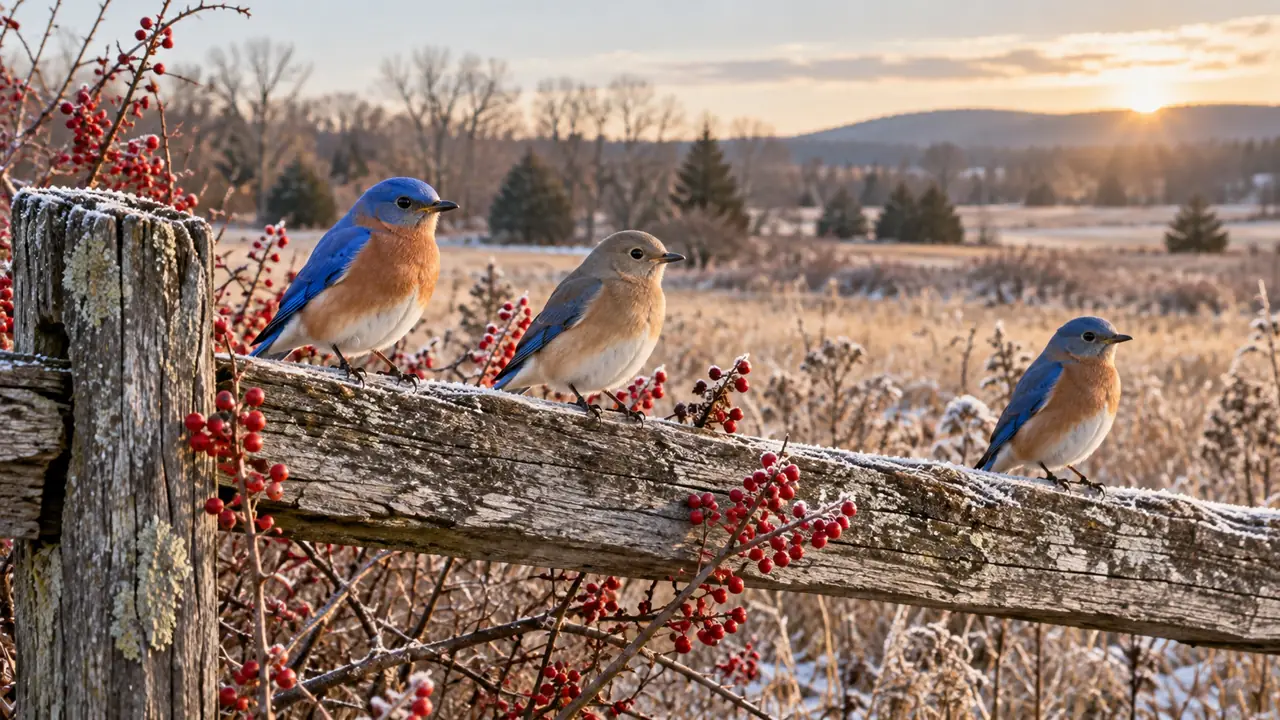
Latitude, elevation and species determine the answer. Winter flocks and a sudden change at one yard can reflect migration, a downslope shift or simply birds concentrating around fruit and open habitat.
Bluebird migration by species
| Species | General pattern | Regional detail |
|---|---|---|
| Eastern Bluebird | Resident to medium-distance migrant | Northern populations migrate; southeastern birds may remain or move a shorter distance. |
| Western Bluebird | Resident to medium-distance migrant | Some remain as far north as British Columbia, some move downslope, and interior birds may travel south. |
| Mountain Bluebird | Short- to medium-distance migrant | Breeds across western North America into Alaska and winters farther south, including parts of Mexico. |
Those categories describe populations, not a promise about one bird. An unbanded bluebird seen in December cannot usually be identified as the same individual filmed in July.
Eastern Bluebirds: resident in the south, migratory in the north
Cornell classifies the Eastern Bluebird as resident to medium-distance migrant. Birds from the northern part of the range leave breeding areas and winter in the southeastern United States or Mexico. Birds in the Southeast may move only a short distance or stay on their breeding territories.
This is partial migration: one species includes both migratory and resident populations. A bluebird remaining in Georgia does not contradict a bluebird leaving Manitoba. They occupy different parts of a broad range and face different winter conditions.
The species can also remain social across seasons. Cornell notes that young from later Eastern Bluebird nests often stay with their parents over winter. A small group on a berry shrub may therefore be a family unit, a local winter flock or migrants stopping in suitable habitat.
Western Bluebirds combine several movement strategies
Western Bluebirds show an especially varied pattern. Some birds in British Columbia remain year-round. Mountain populations may move down a slope into warmer habitat rather than travel far south. Other birds leave interior western breeding grounds and appear in winter areas in Arizona, west Texas and northern Mexico.
Cornell also notes that Western Bluebirds often migrate during the day. That makes a moving group more visible than many songbirds that migrate mainly at night, but a daytime flock is not automatically in migration. Outside the breeding season, Western Bluebirds are social and may form sizeable flocks, sometimes with Mountain Bluebirds and other species.
Mountain Bluebirds make a clearer seasonal movement
Mountain Bluebirds are short- to medium-distance migrants. Their breeding range extends far north and their winter range reaches central Mexico. Cornell reports that migrating flocks can be much larger than a backyard family group.
They also change habitat with the season. Breeding birds use open country that can extend to high elevations. In winter they use lower-elevation meadows, hedgerows, prairies, grasslands and open pinyon-juniper or oak-juniper woodland. A lower winter sighting can therefore combine southward and elevational movement.
The male and female bluebird comparison helps separate plumage differences from species differences before a movement record is labeled.
Why winter flocks gather
Breeding territories are less central after nesting, and bluebirds can gather where winter food is concentrated. Eastern Bluebirds eat insects for much of the year but use large amounts of fruit in fall and winter. Western Bluebirds use mostly fruit and seeds in winter, supplemented by insects; Mountain Bluebirds also take small fruit, seeds and available insects.
Open habitat remains important because bluebirds scan from exposed perches and drop to the ground for prey. A hedgerow with fruit beside a short-grass field can offer both a food patch and a clear view. The winter bluebird guide explains how fruiting habitat, water and safe open structure can help without treating mealworms as a complete diet.
What a feeder camera can and cannot prove
A camera can document date, time, group size, weather and behavior at one location. It cannot establish a bird's origin or destination. Treat the clips as observations to combine with a range map and regional reports.
- Identify the species. Eastern males have a rusty chest, Western males show rust on the chest and upper back, and male Mountain Bluebirds are largely sky-blue.
- Record the setting. Note elevation, open ground, fruiting plants, snow cover and the type of perch.
- Count birds at one moment. Repeated clips may show the same flock cycling through.
- Compare consistent periods. Check the same morning and afternoon windows over several days rather than comparing one busy day with one quiet hour.
- Check weekly abundance maps. Regional eBird patterns can show a seasonal wave, but they still do not identify an individual bird.
The bird-migration tracking guide explains how radar and community observations fit together. Daytime bluebird movement may be better reflected in ground observations than in a single radar snapshot.
Do not use one national migration date
A calendar that says “bluebirds leave in October” is too broad. Western Bluebirds may begin appearing in southwestern winter areas in October and November, while southeastern Eastern Bluebirds may not leave at all. Elevation, weather and food can also shift what a local observer sees.
Use the current species range map and recent local observations for the place and week in question. Record uncertainty when the camera view is too distant for a confident species identification.
Support habitat without trying to stop migration
Provide pesticide-free open foraging space, regionally appropriate fruiting plants, clean water and properly managed nest boxes where the habitat fits. Supplemental mealworms can attract Eastern Bluebirds, but they should complement rather than replace natural foods.
The guide to attracting bluebirds covers open-lawn structure, mealworm presentation and nest-box basics. A nest box does not make a migratory bird remain, and winter use of a cavity does not authorize opening or disturbing it.
Bottom line
Bluebirds do migrate, but the answer is regional. Northern Eastern Bluebirds migrate while many southeastern birds remain. Western Bluebirds may stay, move downslope or travel south. Mountain Bluebirds make short- to medium-distance migrations. Winter flocks can be local families, wintering birds or active migrants, so combine camera evidence with species identification and current regional data.
Sources and verification
- Cornell Lab: Eastern Bluebird range map — resident and migratory populations.
- Cornell Lab: Western Bluebird range map — residency, downslope shifts, interior migration and daytime movement.
- Cornell Lab: Mountain Bluebird range map — short- to medium-distance migration and winter range.
- Cornell Lab: Eastern Bluebird life history — habitat and seasonal diet.
- Cornell Lab: Eastern Bluebird overview — winter family groups and identification context.
- Cornell Lab: bird migration basics — migration terminology and weekly abundance maps.
Questions people ask
Do Eastern Bluebirds migrate south for winter?
Northern populations migrate to the southeastern United States or Mexico. Southeastern birds may move a shorter distance or remain on breeding territories year-round.
Why do you see bluebird flocks in winter?
Bluebirds become more social outside breeding season, and family groups or mixed groups can concentrate around fruit and suitable open habitat. A flock may be local, migrating or wintering.
When do bluebirds migrate?
Timing varies with species, latitude, elevation, food and weather. Use current regional observations rather than one national calendar date.
Does a bluebird at a nest box in winter mean it stayed all year?
No. Bluebirds may inspect or roost near cavities outside breeding season, and an unbanded bird cannot normally be matched to a summer individual from appearance alone.
Written by the Backyard Birdcam team with AI assistance. Found something we got wrong? Email shop@smarternewsnow.com and we will fix it. How we write our guides.