Quick answer
Some blue jays migrate and many don't. They are partial migrants: each fall, part of the population, mostly from the northern edge of the range, moves south in daytime flocks, while many jays stay put all winter. The same jay may migrate one year and stay the next. Most move relatively short distances within North America, and jays remain common all winter across the eastern US.
In this guide
Some blue jays migrate, and many don't. Blue Jays are what birders call partial migrants: every fall, part of the population heads south, while plenty of jays stay in the same woods and yards all winter. Even more puzzling, a jay that migrates one fall may stay home the next.
That is why fall at the feeder can feel unpredictable. Loose flocks of jays stream past in September and October, the regulars vanish for a few weeks while they bury acorns, and then a winter crew settles in. Here is what is going on.
How blue jay migration works
Blue Jays migrate by day, often in the morning, in loose flocks that string out across the sky. Watchers along the shores of the Great Lakes and the Atlantic Coast see the biggest movements, because jays follow shorelines rather than fly across wide water. Fall migration peaks from late September through mid-October, and the return trip happens mostly in May.
The distances are short compared with those of warblers or hummingbirds. Jays don't leave the continent; they shift from the northern part of their range, including southern Canada and the northern states, into the central and southern US. Jays in the Southeast barely move at all.
How to spot migrating jays
Local jays tend to call, land, chase each other and visit feeders. Migrants behave differently: groups of jays passing high overhead, all heading roughly the same direction, south or southwest in fall, often quietly, one small group after another. The best time to watch is a clear morning in late September or early October, especially the day after a cold front brings north winds.
At the feeder, a sudden crowd of jays that stays for a day or two and then moves on is often a migrant flock stopping to refuel. A group that visits every day for weeks is more likely your winter residents.
Which jays go and which stay
Nobody fully understands why one jay migrates and its neighbor doesn't. What is known:
- Northern jays are more likely to move than jays farther south.
- Young jays may be more likely to migrate than adults, but many adults migrate too.
- Individuals switch. Some jays migrate south one year, stay north the next winter, and migrate again after that.
- Food probably plays a part. The size of the fall acorn and beechnut crop appears to influence how many jays leave, although the pattern isn't simple.
Where blue jays go in winter
For most people, the honest answer is "nowhere far." In winter, Blue Jays are found across nearly all of the eastern and central US, from New England and the Great Lakes to Florida and Texas. Numbers thin out at the northern edge of the range, and in some years more jays linger in the North than others.
Blue Jays are mainly birds of the East and the Great Plains. West of the Rockies, the jays at your feeder are more likely to be Steller's Jays or scrub-jays, which are largely year-round residents, although some Blue Jays wander west each year, especially in fall and winter.
So when the jays at your feeder seem to disappear in fall, the likeliest explanations are that they are busy in the woods caching food, that they have gone quiet after their summer molt, or that a new set of jays has replaced the summer birds. Many of the jays you see in winter may not be the same birds that nested nearby.
What feeder watchers notice through the year
| Time of year | What the jays are doing | What you may notice |
|---|---|---|
| July to August | Families with young, adults molting | Noisy family groups; patchy or even bald-headed jays during the molt |
| September to October | Migrants moving, locals caching acorns | Flocks overhead in the morning, jays carrying off peanuts and seed, sometimes a lull at feeders when acorns ripen |
| November to March | Winter residents settled in | A steady group of jays at feeders, hawk-like calls, lots of activity after snow |
| April to May | Nesting begins; northbound migrants pass through | Flocks moving north in May; local pairs grow quiet around their nests |
| June | Nesting continues; first young leave the nest | Jays stay secretive near nests; noisy fledglings start following their parents |
The bald-headed jays of late summer alarm a lot of people, but they are usually molting all their head feathers at once, and the feathers grow back within weeks. See why birds lose their head feathers for more.
Blue jays in fall: the great acorn harvest
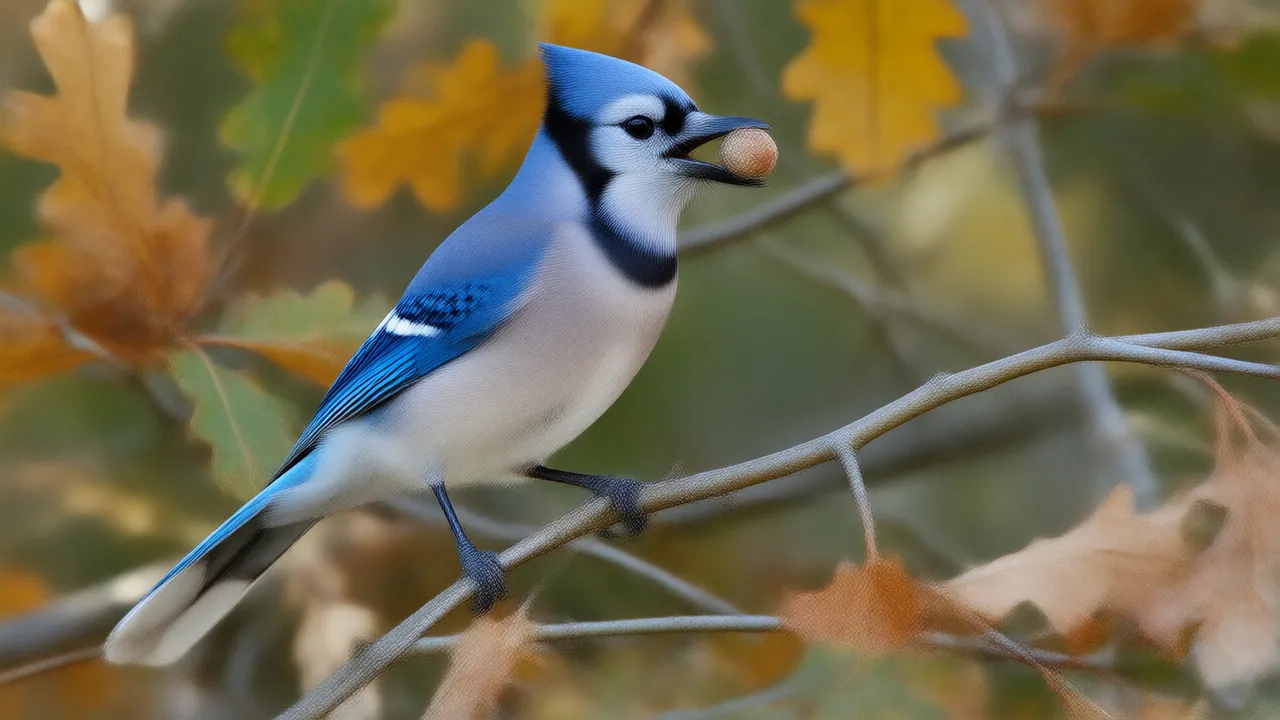
Fall is caching season. A Blue Jay can carry several acorns at a time, packed into its throat and mouth with one more held in its bill, and fly off to bury them in the ground or tuck them under leaves, bark or moss. Over a single fall, one jay can store thousands of acorns and other nuts, then dig many of them up in winter.
Not every cache is recovered, and the forgotten acorns sprout. Jays often carry acorns well away from the parent tree before burying them, which makes them important planters of oak forests.
The same instinct explains what happens at the feeder in October. Jays fill up on sunflower seed or peanuts and fly off, return a few minutes later, and repeat until the feeder is empty. They aren't eating it all; they are storing it. If this is happening in your yard, blue jays emptying the bird feeder has ways to share the seed.
How blue jays get through winter
Jays that stay rely on the food they stored, on whatever nuts, seeds, berries and insects they can find, and on feeders. They fluff their feathers to trap warm air on cold mornings and roost in dense evergreens at night.
Winter is also when jays are easiest to hear. Along with their familiar "jay! jay!" calls, they mimic hawks, especially the Red-shouldered Hawk, often well enough to fool people. The guide to blue jay sounds covers their range of calls, and what birds stay all winter covers the rest of the cold-season crowd.
Feeding blue jays through fall and winter
- Whole peanuts in the shell are a favorite. Offer them on a platform or in a wide tray, and keep them dry.
- Black oil sunflower and striped sunflower in a hopper or on a platform. Jays prefer to perch on something sturdy rather than cling.
- Suet in a cage feeder, which jays will visit in cold weather.
- Cracked corn in small amounts on a tray, cleaned up daily so it doesn't mold.
- Water. A heated bird bath brings in jays that aren't interested in your seed.
- Oaks for the long term. Planting a native oak gives jays the food they depend on most, and gives you jays for decades.
For a full setup, see how to attract blue jays. If jays have gone quiet in your yard this fall, keep feeders filled; jays usually return to feeders by late fall or early winter.
Sources and editorial verification
Editorial boundary for Do Blue Jays Migrate? The Fall Flocks Explained: Migration timing and abundance are probabilistic and location-specific; live forecasts and current regional data supersede fixed calendar dates. Check linked sources and the responsible local authority again before acting because product documentation, disease conditions, wildlife rules and seasonal observations can change.
- Cornell Lab of Ornithology — checked for migration terminology.
- Cornell Lab of Ornithology eBird Science — checked for modeled seasonal abundance.
- Cornell Lab of Ornithology and Colorado State University — checked for nightly migration forecasts.
- Cornell Lab of Ornithology — checked for species identification.
- US Fish and Wildlife Service — checked for native plants.
Questions people ask
Where do blue jays go in winter?
Most stay within the eastern and central US. Jays from the northern edge of the range shift south, mostly over relatively short distances, while many jays elsewhere stay put all winter.
Why do blue jays disappear from feeders in the fall?
Usually because they are busy caching acorns and other nuts in the woods, or because local jays have been replaced by migrants passing through. Most return to feeders by late fall or winter.
Do blue jays migrate in flocks?
Yes. Migrating jays travel by day in loose flocks, most visibly along the Great Lakes and the Atlantic Coast in late September and October, and again in May.
Are the blue jays in winter the same ones from summer?
Not necessarily. Some summer jays migrate south and jays from farther north may arrive, so the winter group at a feeder can include different birds.
Written by the Backyard Birdcam team with AI assistance. Found something we got wrong? Email shop@smarternewsnow.com and we will fix it. How we write our guides.