Quick answer
To attract Greater Roadrunners, create semi-open habitat inside their natural range: preserve native shrubs or cactus for cover, leave open ground and connected travel lanes, retain safe low perches and support insects and other natural prey. Do not hand-feed meat or pet food. Roadrunners are predators and may hunt birds near feeders or nest boxes, so monitor the whole station and pause feeding if it becomes a hunting site.
In this guide
- Make sure Greater Roadrunners occur locally
- Build a semi-open habitat mosaic
- Use native plants to support natural prey
- Do not feed a roadrunner by hand
- Understand the songbird tradeoff
- Protect nest and roost cover
- Reduce traffic and pet hazards
- Use water cautiously
- Observe without changing behavior
- What not to do
- Bottom line
- Sources and verification
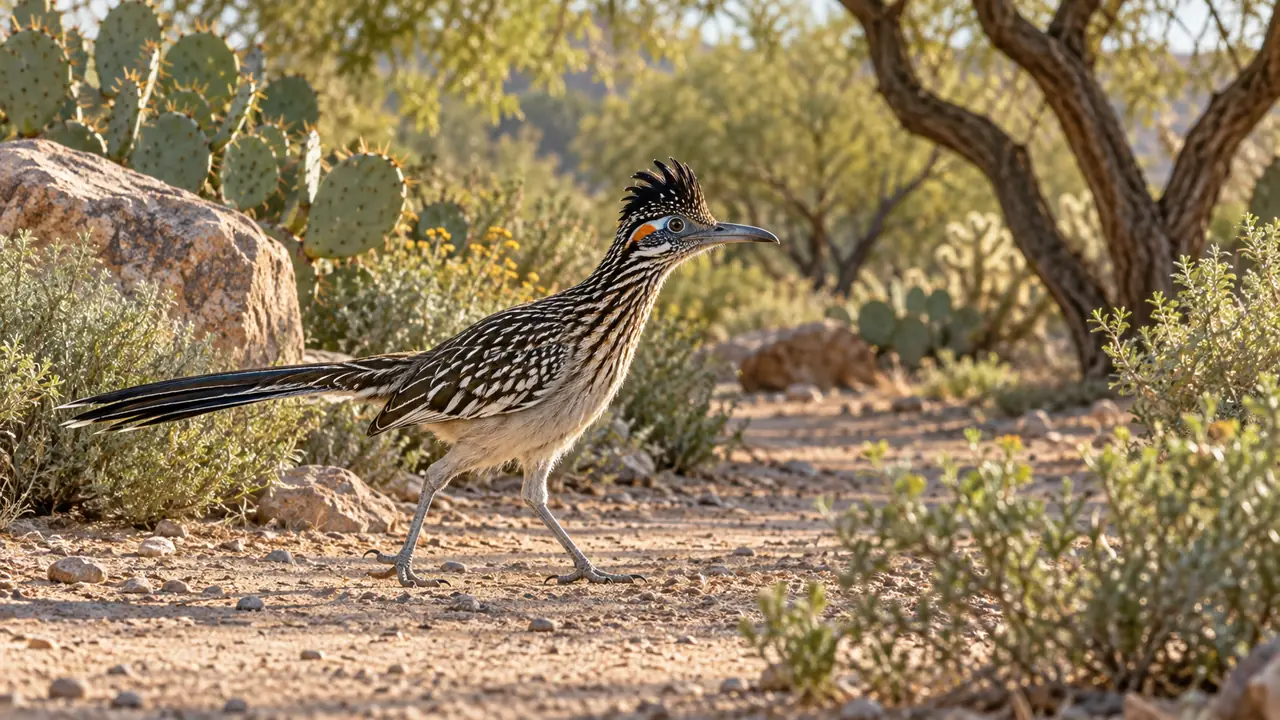
Attract Greater Roadrunners with habitat, not handouts. Inside their natural range, they favor semi-open landscapes with bare ground or paths for running, scattered shrubs or small trees for cover, safe perches and abundant natural prey.
Do not put out meat, pet food or live prey. A roadrunner is a wild predator, not a conventional feeder bird, and food conditioning can create conflict without supplying the territory and cover it needs.
Make sure Greater Roadrunners occur locally
This guide is about the Greater Roadrunner, the species found in the United States. Cornell describes its core habitat across the Southwest and northern California, with an eastward range extension into parts of Missouri, Arkansas, Oklahoma and Louisiana.
Check a current range map and recent local records before changing the yard. A suitable-looking property outside the occupied range will not produce a roadrunner, and an individual at the edge of the range may be uncommon.
Build a semi-open habitat mosaic
Roadrunners hunt by moving quickly across the ground. Cornell lists creosote, mesquite, chaparral, tamarisk, grasslands, riparian woodland, canyons, pinyon-juniper and cholla grassland among their habitats. Texas Parks and Wildlife summarizes the shared structure as bare ground with scattered trees and bushes.
| Habitat element | Why it matters | What to do |
|---|---|---|
| Open ground or path | Provides a route for running and scanning | Keep connected lanes between cover patches. |
| Native low shrubs or cactus | Offers concealment, nest structure and prey habitat | Choose species native to the local ecoregion. |
| Small tree or sturdy bush | Can provide a perch or concealed nest support | Retain safe structure rather than pruning every interior branch. |
| Rock, post or open perch | Allows calling, scanning and morning sun exposure | Keep stable existing features away from roads. |
| Undisturbed edge | Supports insects, lizards and other prey | Use targeted maintenance instead of clearing the entire yard. |
A uniformly dense hedge is not the same as a habitat mosaic. The bird needs room to run as well as places to disappear. The site's bird-friendly garden design guide helps plan cover without turning every square foot into either lawn or thicket.
Use native plants to support natural prey
Greater Roadrunners eat mostly animals: insects, centipedes, scorpions, reptiles, amphibians, small mammals and sometimes birds. Cornell says fruit, seeds and other plant material form a smaller part of the winter diet.
Planting locally native shrubs, grasses and flowering plants can support the insects and small animals already adapted to the region. The U.S. Fish and Wildlife Service recommends native plants and layered structure because they provide food, shelter and insect-rich habitat.
Reduce broad, routine pesticide use and use integrated pest management when action is necessary. The goal is not to release purchased insects, rodents or reptiles; it is to stop removing the existing food web.
The guide to native plants for birds provides a seasonal planning framework, but plant choices should come from a regional native-plant source.
Do not feed a roadrunner by hand
Online videos sometimes show roadrunners taking hamburger, hot dogs, pet food or mealworms from a person. That proves an individual will accept a handout, not that feeding is appropriate.
- Do not place raw meat, processed meat or pet food outdoors.
- Do not buy live animals as prey.
- Do not use food to draw a bird toward a camera, doorway or road.
- Do not approach a nest or fledgling to create a closer encounter.
- Check local wildlife regulations before any supplemental feeding.
Handouts can concentrate activity near people and attract mammals, rodents, insects and free-roaming pets. Habitat gives the bird a reason to use the area while preserving normal foraging.
Understand the songbird tradeoff
Roadrunners are charismatic, but they are predators. Cornell reports that they sometimes grab birds at backyard feeders or nest boxes and may also eat eggs or chicks. Attracting one can therefore conflict with a feeding station designed to concentrate smaller birds.
If footage shows a roadrunner repeatedly stalking the same feeder, remove the feeder for a time and eliminate spilled seed that concentrates prey. Do not punish or chase the predator. Change the human-created hunting opportunity.
Likewise, do not place a nest box directly beside an open roadrunner travel lane. Keep cats indoors; the site's outdoor-cat safety guide explains why pets add another predator to the same space.
Protect nest and roost cover
Cornell says a pair commonly places its stick nest about 3 to 10 feet or more above ground in a sturdy bush, cactus or small tree, usually shaded and concealed. That is a description, not an instruction to install a platform at a fixed height.
Watch established travel routes before pruning. If an active nest is present, keep people and pets back and do not cut, move or inspect it closely. Native shrubs with dense interior branching are more useful than ornamental cover that is repeatedly sheared open.
Reduce traffic and pet hazards
Roadrunners cross roads and driveways while pursuing prey or moving through a territory. Keep vehicle speed low on private drives and avoid placing water, a camera or another attraction near the street.
Cornell identifies development, habitat fragmentation, household pets, feral animals, pedestrians and traffic as threats. Connect cover patches within the property so the bird does not have to cross an exposed patio or busy road for every movement.
Use water cautiously
Greater Roadrunners obtain substantial moisture from prey and do not require a special feeder. A clean, shallow water source may serve many birds in an arid yard, but it should not be used as bait for a close photo.
Keep water fresh, provide an easy exit and place it where cats cannot ambush visitors. Stop if the feature creates crowding, mosquitoes or repeated predator conflict.
Observe without changing behavior
Place a camera along a natural path or scanning perch only after confirming that it will not obstruct the route. Use motion detection and review remotely. Do not bait the frame or move equipment toward an active nest.
Roadrunners often sunbathe after a cold night, call from rocks or posts and patrol a large territory. A few brief visits may be normal use of one edge rather than evidence the bird lives inside the yard.
What not to do
- Do not handle, trap or relocate a roadrunner.
- Do not use poison to manipulate its prey.
- Do not destroy snakes or lizards to make the yard feel safer while claiming to build roadrunner habitat.
- Do not add reflective tape, netting or loose line that can entangle wildlife.
- Do not expect a bird to control a rodent or snake problem.
The article on snakes around bird feeders covers safe conflict reduction without asking a predator to act as pest control.
Bottom line
Attract Greater Roadrunners by preserving the semi-open habitat they use: connected running space, native scrub, natural prey, safe perches and low disturbance. Skip handouts. Monitor songbird feeders and nest boxes because the same roadrunner you welcome may hunt there, and change the feeding setup rather than blaming the wild predator.
Sources and verification
- Cornell Lab: Greater Roadrunner life history — habitat, diet, nesting, behavior and conservation threats.
- Cornell Lab: Greater Roadrunner overview — current range, field behavior and identification context.
- Texas Parks and Wildlife: roadrunners — open-ground structure, scattered cover and regional habitat breadth.
- U.S. Fish and Wildlife Service: backyard birds — native plants, habitat layers and natural food-web support.
Questions people ask
What habitat attracts Greater Roadrunners?
They use open or semi-open country with patches of scrub, small trees, cactus or chaparral, plus bare ground or paths where they can run and hunt.
What can you feed a roadrunner?
Do not use handouts as an attraction method. Roadrunners are opportunistic predators that obtain insects, reptiles, small mammals and other natural foods by hunting.
Will a roadrunner eat birds at my feeder?
It can. Cornell reports that Greater Roadrunners sometimes take birds from backyard feeders or nest boxes. Pause or move the feeding activity if a roadrunner begins using it as a hunting station.
Do roadrunners need a desert yard?
No. They also occur in grassland, riparian woodland, canyon, pinyon-juniper and some scrubby eastern habitats, but they generally need open ground with scattered cover.
Written by the Backyard Birdcam team with AI assistance. Found something we got wrong? Email shop@smarternewsnow.com and we will fix it. How we write our guides.