Quick answer
Bird feeders can attract snakes indirectly, not because snakes eat seed. Spilled food can support rodents and other prey, while dense plants or debris provide cover. Control seed and shelter, keep people and pets away from any snake, never handle it, and call local wildlife control when the location or species creates risk.
In this guide
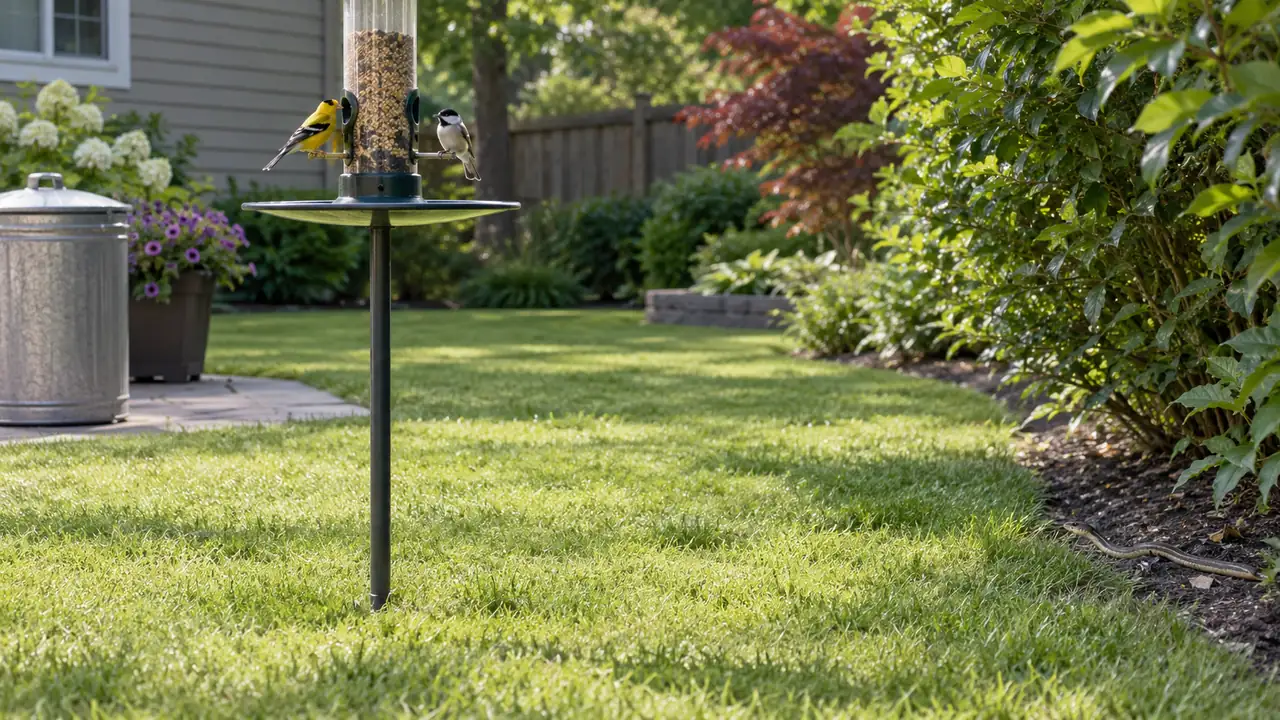
Bird feeders do not attract snakes because snakes want birdseed. They can attract snakes indirectly when spilled seed supports mice and other prey, when visiting birds become prey, or when dense plants, woodpiles and debris provide cover near the feeding station.
The safest response is to remove food and shelter, not confront the snake. Keep people and pets away, let the animal leave, and contact local wildlife control if it remains in a risky location or its identity is uncertain.
How a feeder changes the yard
| Feeder-related change | Why it may matter to snakes | Best control |
|---|---|---|
| Whole seed accumulates on the ground | Rodents and other small animals may feed there. | Feed smaller amounts and remove spill daily. |
| Seed is stored in a loose bag or open bin | Rodents can establish close to the house. | Use a tight, pest-resistant container. |
| Dense low growth touches the feeder area | Prey and snakes gain concealment. | Keep an open, visible service zone. |
| Boards, rocks or firewood sit beside the station | Crevices provide shelter and temperature refuge. | Move debris and stacked materials away from the house and feeder. |
| Birds or rodents gather predictably | A predator may investigate the prey concentration. | Pause feeding while resolving the attractant. |
Utah State University Extension explicitly connects seed below feeders with rodents and the snakes that may follow those prey. Iowa State Extension likewise explains that many snakes eat rodents and occupy holes created by small mammals. A snake sighting is therefore a yard-ecology clue, not proof that the feeder itself “called” the snake.
What to do when a snake appears
- Stop, back away and give the snake an unobstructed route to leave.
- Bring children and pets indoors or keep them far from the area.
- Do not touch, corner, capture or kill the snake.
- If it can be done without approaching, note its location or take a zoomed photograph from a safe distance.
- Call local animal control, a wildlife agency or a qualified wildlife professional when the snake is inside a building, cannot leave safely or may be venomous.
Do not use pupil shape, head shape or another single visual shortcut to make a close-range identification. Regional species vary, and moving closer creates the very exposure you need to avoid.
Remove the indirect food source
Take the feeder down temporarily if rodents, repeated snake visits or a large spill patch are present. Collect whole seed and hulls without leaving another food pile elsewhere. Then correct the source:
- fill with only what birds will consume promptly;
- repair leaking ports and unstable mounts;
- choose seed that local birds actually eat;
- use a cleanable catcher tray that does not hold wet food;
- empty the tray frequently and clean it like any other feeder surface;
- store seed in a tightly closed, pest-resistant container.
The camera test in why birds throw seed out separates sorting from a mechanical leak. The seed-catcher guide covers drainage and cleaning tradeoffs.
Break the rodent link
Seed management is more effective than attempting to repel a predator while its prey remains. Check after dark with the feeder removed and review camera clips for mice or rats rather than assuming every missing seed was eaten by birds.
Move pet food indoors, secure garbage, repair seed storage and clear food from sheds or garages. Do not set wildlife-harming sticky traps outdoors. If rodents are established, use the prevention steps in keeping rats away from bird feeders and obtain local pest-management advice.
The bird-seed storage guide covers containers, spills and signs of contamination. Do not continue using seed that rodents have contaminated.
Reduce shelter without stripping the whole habitat
Snakes are part of functioning ecosystems and many are harmless, beneficial predators. The goal is not to remove every native plant. Create a visible buffer around the feeder and buildings while preserving habitat farther away.
- Keep grass and groundcover immediately around the service path short enough to see where you step.
- Move loose boards, sheet material and debris away from the station and foundation.
- Store firewood on a rack away from the house rather than beside the feeder.
- Trim branches or dense growth that touch exterior walls or conceal entry points.
- Repair foundation, door and utility gaps only after confirming no animal will be trapped inside.
Avoid turning the entire yard into bare ground. Keep native cover in planned zones away from doors, play areas and the feeding station.
Methods to avoid
Utah State Extension advises against snake repellents, sulfur, mothballs and outdoor sticky traps. Mothballs are pesticides with restricted label uses, not general yard deterrents, and can endanger people, pets and wildlife. Sticky traps can capture non-target animals and cause prolonged suffering.
Do not use a shovel, firearm, glue trap, poison or improvised relocation method. Laws and protected species vary, and most bites happen during close interaction. A qualified local professional can choose a lawful response when exclusion alone is not enough.
Can a camera help?
A feeder camera can show whether rodents visit first, where a snake travels and whether spill continues after birds leave. Use the existing remote view; do not walk closer for a better clip, shine a light at the animal or block its exit.
Save the time, route and a distant image for local identification. A camera cannot determine whether an unseen snake is venomous, and one sighting cannot prove what attracted it.
If someone is bitten
Treat an unknown snakebite as an emergency. Move away from the snake, call emergency services, keep the person calm and avoid unnecessary movement. Do not try to catch or kill the snake and do not drive yourself if symptoms could impair you.
CDC/NIOSH guidance warns against cutting the wound, attempting to suck out venom, applying ice or using a tourniquet. Follow emergency-services and poison-control instructions; this article is not a substitute for medical care.
When can the feeder return?
Rehang it only after spills are controlled, seed storage is secure, rodents are no longer using the station and the area has a visible service buffer. Start with a small quantity and inspect the ground each day.
If snake or rodent visits resume, remove the feeder again. Native plants can support birds without a concentrated seed source while the conflict is resolved.
Bottom line
Bird feeders can attract snakes indirectly by concentrating prey and creating shelter-rich feeding areas, not because snakes eat seed. Control spilled food, rodents, storage and nearby cover; never handle the snake or use harmful deterrents; and get local professional help for a risky encounter.
Sources and verification
- Utah State University Extension: snakes in yards — feeder spill, rodents, shelter and ineffective deterrents.
- Iowa State University Extension: dealing with snakes around homes — prey, shelter, exclusion and ecological role.
- Cornell Lab: unwanted yard visitors — spilled seed and rodent management.
- CDC/NIOSH: venomous snakes — encounter and bite-emergency precautions.
Questions people ask
Do snakes eat birdseed?
No. The feeder connection is indirect: spilled seed may attract rodents and birds that are prey, while nearby cover can make the area usable for a snake.
What should you do if a snake is under your bird feeder?
Back away, keep children and pets indoors, give the snake a clear exit and do not touch or corner it. Contact local animal control or a wildlife professional if it cannot leave safely or may be venomous.
Do snake repellents or mothballs work around feeders?
Utah State Extension advises against snake repellents, sulfur, mothballs and outdoor sticky traps. Remove spilled food, prey and shelter instead.
Should you take the feeder down after seeing a snake?
Temporarily remove it if spills, rodents or repeated visits are present. Rehang only after food is controlled, storage is secure and the service area is open and visible.
Written by the Backyard Birdcam team with AI assistance. Found something we got wrong? Email shop@smarternewsnow.com and we will fix it. How we write our guides.