Quick answer
A good bird house kit for kids uses solid, untreated wood, has an entrance hole sized for a real bird (1 1/8 inches for chickadees, 1 1/2 inches for bluebirds), drainage and air holes, a side or roof that opens for cleaning, and no perch. Pre-drilled, screw-together kits suit young children; older kids can build from plans. Paint only the outside, in light colors.
In this guide
A birdhouse kit works for real birds when it follows the same rules as any good nest box: solid untreated wood, an entrance hole sized for an actual species, a roomy floor, drainage and air holes, a way to open it for cleaning, and no perch. Plenty of kits made for children meet those rules. Many craft kits do not, and those are better kept indoors as decorations.
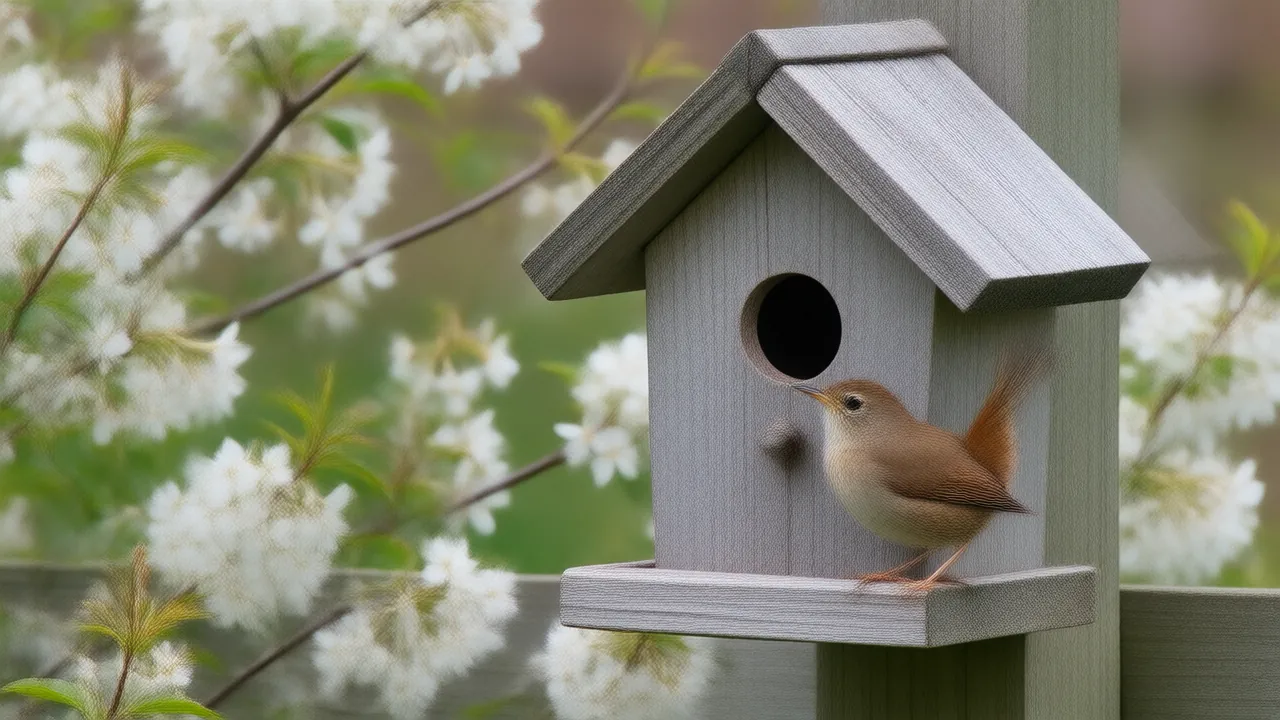
For children under about 8, choose a kit with pre-drilled holes and screws or pre-started nails, so they can do the assembly while an adult steadies the pieces. Older kids can handle kits with more parts or build from plans. A plain chickadee or wren box with a 1 1/8 to 1 1/4 inch hole is the easiest first project and a good match for a wooded or shrubby yard.
What makes a kid's birdhouse kit functional
Before you buy, or before you start building, check the kit against this list:
- Solid wood. Untreated cedar or pine, ideally about 3/4 inch thick. Thin craft plywood, balsa and cardboard overheat in the sun and fall apart after one season of rain.
- A hole sized for a real bird. 1 1/8 inches suits chickadees, 1 to 1 1/4 inches suits House Wrens, 1 1/4 inches suits titmice and nuthatches, and 1 1/2 inches suits bluebirds and Tree Swallows. A kit that does not say which bird it is for is a warning sign. The bird house hole size chart lists the sizes for other species.
- Enough room inside. A floor of at least 4 by 4 inches, with several inches between the hole and the floor (about 6 inches in most chickadee and bluebird plans), so the nest sits farther from a reaching paw.
- Drainage and ventilation. A few small holes or cut corners in the floor, and gaps or holes near the top of the walls.
- A door for cleaning. One side, the front or the roof should swing open on a hinge or a pair of pivot nails and close with a screw or latch.
- No perch. Many kits include a little dowel under the hole. Leave it off. Native cavity nesters do not need it, and it helps House Sparrows and predators.
- A roof that overhangs the front, so rain does not run into the hole.
If the inside of the front wall is smooth, have an adult cut or scratch a few shallow grooves below the hole before assembly. Young birds use them like a ladder when it is time to leave.
Signs a kit is really a decoration
A tiny box that fits in the palm of a hand, several holes in one small box, a thatched or glued-on roof, bright paint on the inside, or no hole size listed at all. These can be fun craft projects, but they belong on a shelf, not on a post.
Tools and tasks by age
Most kits can be built by children of almost any age with the right split of jobs. These ranges are rough guides; a careful 6-year-old may be ready for more than a distracted 10-year-old.
| Age | What kids can do | What the adult does |
|---|---|---|
| 3 to 5 | Sand edges, tap pre-started nails with a light hammer while an adult steadies the piece, paint the outside | Starts every nail or screw, holds the parts, handles glue |
| 6 to 8 | Hammer pre-started nails, drive screws into pre-drilled holes with a hand screwdriver, follow picture instructions | Clamps pieces, checks the fit, helps with the roof and door |
| 9 to 12 | Build most kits alone from written instructions, measure, drill pilot holes with supervision | Supervises the drill, checks the hole size and the door |
| 13 and up | Build from plans and raw boards, cut with a handsaw, drill the entrance hole with the correct bit | Supervises cutting and power tools |
A few safety habits make the project go well at every age: safety glasses for everyone hammering, a small lightweight hammer for small hands, a clamp or vise so fingers are not holding pieces near the nail, and sandpaper for any splinters. Work on a sturdy table, not the floor, and let the kids do as much of the real work as they safely can. The house means more to them that way.
Decorating safely
Kids love to paint, and a painted birdhouse is fine as long as the paint stays where birds will not be harmed by it:
- Outside only. Never paint or varnish the inside of the box or the edges of the entrance hole.
- Light, natural colors. Tan, gray, pale green, white and soft browns keep the box cooler. Dark colors soak up the sun and can overheat the nest in summer. The guide to what color to paint a birdhouse has more on this.
- Water-based exterior paint or stain, and let it dry and air out for several days before hanging the house.
- No loose decorations. Skip glitter, sequins, beads, googly eyes, yarn and ribbon. Pieces come off in the weather, and birds can swallow them or get tangled.
For kids who want to go wild with color, a good compromise is to build two: a plain, bird-ready house for the yard and a second one to decorate any way they like for their room. Unpainted cedar is perfectly good too; it weathers to a soft silver gray.
Putting it up where birds will find it
Which bird moves in depends on both the hole and the yard around it:
- House Wrens are the most likely tenants in many shrubby suburban yards across the northern and western US. They take a 1 to 1 1/4 inch hole and will even use a hanging house. In much of the Southeast they are mainly winter visitors that do not nest there, so a chickadee box is the better bet.
- Chickadees prefer wooded yards and a 1 1/8 inch hole mounted on a tree or post.
- Bluebirds need open lawns or fields and a 1 1/2 inch hole on a pole about 5 feet up.
Mount the house firmly on a post, pole or tree trunk rather than letting it swing from a branch; except for wrens, most cavity nesters avoid a moving house. Five to 10 feet up works for wrens and chickadees. Face the hole away from the prevailing wind, give it some afternoon shade in hot climates, and keep it away from busy feeders. Pick a spot the kids can see from a window. The guide on where to hang a birdhouse covers the finer points.
Timing matters too. Birds start choosing nest sites in late winter and early spring, often February in the South and March or April farther north, so a kit built over the holidays is perfectly timed to go up by early spring. See when to put up a birdhouse for your region.
Watching the nest the right way
The best lesson a birdhouse teaches is patience. Native birds, their nests and their eggs are protected by federal law, so the rule for the whole family is simple: watch, do not touch. Resist the urge to open the box while a family is using it.
There is plenty to see from a window or a spot a good distance away. Kids can keep a nest journal and record:
- The first day a bird looks in the hole, and the first day it carries in nesting material.
- When both parents start making frequent trips with insects, usually a sign that the eggs have hatched.
- How many feeding trips they count in five minutes, morning and evening.
- The first day they hear the babies calling, and the day the young birds leave.
Once the nesting season is over and the box has been empty for a while, an adult can open it, remove the old nest with gloves on, and close it up for next year. More ideas for young birders are in bird watching with kids.
Sources and editorial verification
Editorial boundary for Bird House Kits for Kids That Birds Will Really Use: Nest occupancy and legal protection must be checked before inspection, removal, repair or exclusion; current authority guidance supersedes any general timing; Product fit, program availability and accessibility change; verify current specifications and local participation details before spending money. Check linked sources and the responsible local authority again before acting because product documentation, disease conditions, wildlife rules and seasonal observations can change.
- Cornell Lab NestWatch — checked for minimizing nest disturbance.
- Cornell Lab NestWatch — checked for untreated wood and wall thickness.
- US Fish and Wildlife Service — checked for federal migratory-bird protection framework.
- Cornell Lab of Ornithology — checked for species identification.
- Cornell Lab of Ornithology — checked for photo and sound identification as suggestions.
- Cornell Lab of Ornithology eBird Science — checked for modeled seasonal abundance.
Questions people ask
What is the best birdhouse for a child to build?
A simple wren or chickadee box with a 4 by 4 inch floor and a 1 1/8 to 1 1/4 inch hole. It is small, quick to build and likely to be used in many yards.
Can kids paint a birdhouse?
Yes, on the outside only, in light colors, with water-based exterior paint. Let it dry and air out for several days before hanging it.
What age can a child build a birdhouse kit?
Preschoolers can sand and paint with help, children around 6 to 8 can build pre-drilled kits with an adult nearby, and many 9 to 12 year olds can build a kit mostly on their own.
Should a kid's birdhouse have a perch?
No. Native birds that use birdhouses do not need one, and a perch mainly helps House Sparrows and predators.
Written by the Backyard Birdcam team with AI assistance. Found something we got wrong? Email shop@smarternewsnow.com and we will fix it. How we write our guides.