Quick answer
Yes. Rats climb wooden posts, rough poles and thin metal hooks, and they jump onto feeders from nearby fences, shrubs and deck rails. A smooth metal pole with a long cylinder baffle, its lower edge at least 4 feet up and the pole 8 to 10 feet from anything climbable, stops them. Cleaning up spilled seed every day matters just as much.
In this guide
Yes, rats can climb a bird feeder pole, and they are good at it. A wooden post, a rough or textured pole, or a thin metal hook gives them plenty to grip, and a feeder hung near a fence, shrub or deck rail lets them skip the climb and jump. A smooth metal pole with a long cylinder baffle, standing well away from anything they can climb, keeps them off the feeder itself.
Climbing is usually the smaller half of the problem, though. Most rats around feeders are eating seed that has already hit the ground. Fix the pole and clean up underneath it, or the rats keep coming back.
How rats reach bird feeders
Two rat species cause most of the trouble around American homes, and they behave differently:
- Norway rats, also called brown rats, are heavy-bodied and found across the US. They dig burrows and spend most of their time on the ground, but they climb well when food is up high.
- Roof rats, also called black rats, are slimmer, with a tail longer than the head and body. They are agile climbers that run along branches, fences and utility lines. They are most common in warmer southern and coastal areas, including the Southeast, the Gulf Coast and the West Coast.
Either kind can grip wood, bark, brick and wire, and can shimmy up a thin pole or pipe by wrapping around it. They also drop onto feeders from overhanging branches and run along clotheslines and wires to reach a hanging feeder. Rats like to travel along edges, so a feeder beside a fence or the side of a shed sits right on their usual route.
Is it rats or squirrels?
Gray, fox and red squirrels feed in daylight, so seed that disappears overnight points to rats, mice, raccoons or flying squirrels, which are active only at night. Other signs of rats:
- Dark, capsule-shaped droppings, roughly half an inch to three-quarters of an inch long, near the feeder or along walls.
- Burrow openings a few inches wide under shrubs, decks, sheds or compost bins.
- Narrow worn paths in grass or mulch, and greasy dark rub marks along walls and fences.
- Gnawed seed bags or bins in the garage or shed.
Pole setups that stop rats
The same setup that stops squirrels stops rats, because a rat cannot jump as high as a gray squirrel. What matters is a smooth pole, a baffle it cannot get past, and open space all around.
| Setup | Stops climbing rats? | Why |
|---|---|---|
| Bare wooden post | No | Wood gives claws an easy grip |
| Thin metal hook, no baffle | Often not | Rats can wrap around and shimmy up a narrow pole |
| Smooth metal pole with a cone baffle | Usually | Works if the baffle is snug, wide and mounted high enough |
| Smooth metal pole with a cylinder baffle | Yes, the most reliable | A long smooth tube with a closed top gives nothing to grip or reach around |
| Any pole near a fence, shrub or roof | No | Rats jump or drop onto the feeder and skip the pole |
Cylinder baffles
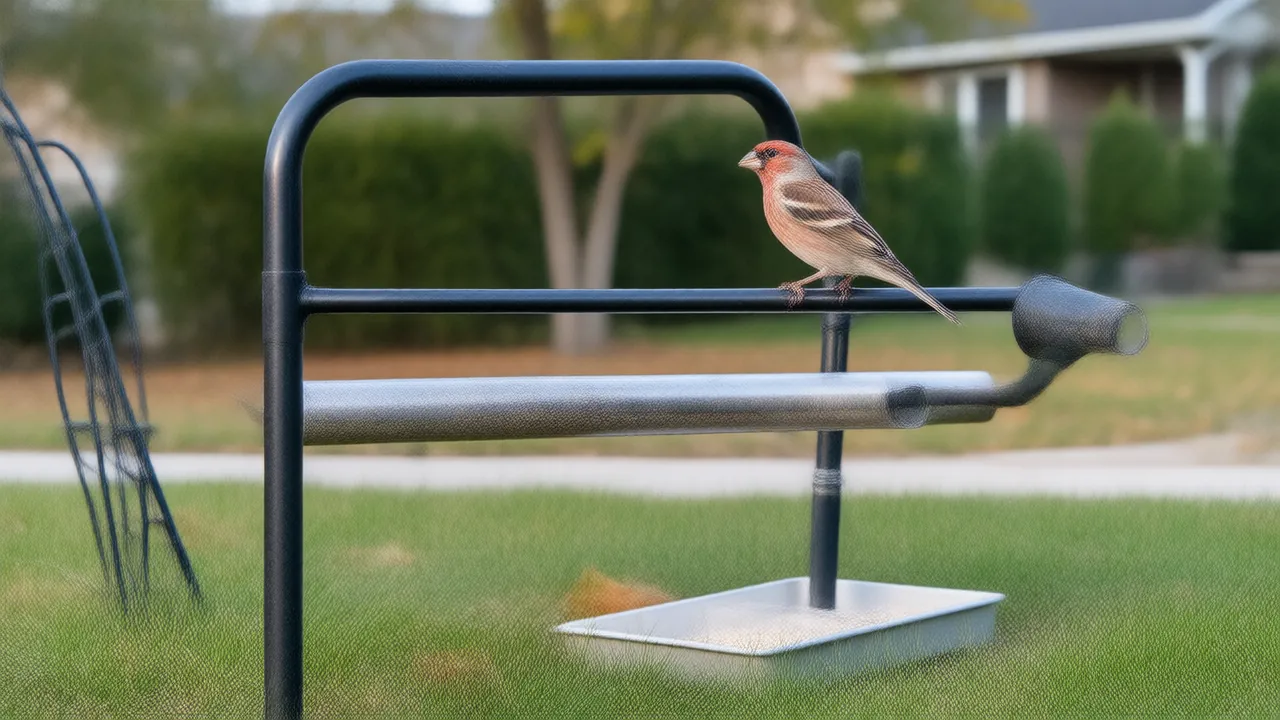
A cylinder baffle, sometimes called a torpedo or stovepipe baffle, is a metal tube with a closed top that clamps around the pole. Mount it so its lower edge is at least 4 feet off the ground, and check that the top fits snugly, with no gap between baffle and pole for a small animal to squeeze through. Because it is long and smooth, it also stops raccoons, which can reach around some cone baffles.
Cone baffles
A cone baffle flares out below the feeders like an upside-down funnel. It works against rats when it is wide, tight to the pole and high enough that nothing can jump past it. Some are designed to tilt when an animal grabs the rim, which makes them harder to beat.
Placement
Stand the pole 8 to 10 feet from fences, trees, shrubs, deck rails, woodpiles, sheds and roofs, with no branches hanging over it. Hang every feeder above the baffle, with nothing, including chains and trays, dangling below its top. The guide to placing a squirrel baffle walks through the heights and distances step by step, and stopping squirrels climbing a bird feeder pole compares the baffle types in more detail.
Deep snow raises the ground. After a big storm, check that the baffle's lower edge is still about 4 feet above the snow, not above the lawn buried under it.
Clean up the ground: the part that ends the problem
A perfect pole does not help if dinner is waiting on the ground. Birds flick seed out of feeders all day, and ground-feeding birds leave plenty behind. Rats find that spill fast and come back every night. For rodents and snakes around feeders, check the spilled-food and shelter context rather than treating a pole baffle as the whole solution. The same ground-food check matters when investigating skunks under a feeding station.
- Catch the spill. A seed catcher tray under the feeder holds dropped seed and hulls off the ground.
- Offer food with less waste. Hulled sunflower chips leave no shells, and mixes padded with milo, cracked corn or red millet get raked out by birds hunting for the sunflower. Straight black oil sunflower or sunflower chips spill less than cheap mixes.
- Feed what birds finish by evening. Put out only what gets eaten in a day, so feeders and trays are empty at dusk. Bring tray and platform feeders in at night.
- Sweep or rake under the feeders before dark, every day while rats are active.
- Pause ground feeding. Stop scattering seed on the ground until the rats are gone.
- Take away cover. Rats prefer to move under cover. Move feeders away from dense shrubs, ivy, woodpiles and stacked materials, and keep the grass around the pole short.
- Store seed in metal. A metal can with a tight lid stops rats and mice from chewing into it. Paper and plastic bags do not.
- Check other food sources. Pet food left outside, fallen fruit, open compost and loose trash lids feed rats too.
Seed treated with hot pepper can help, because mammals find it unpleasant while birds eat it normally. It does not replace cleanup; it just makes the spilled seed less rewarding.
What not to use
Some common rat and squirrel remedies put birds at risk:
- Grease, petroleum jelly, oil or sticky coatings on the pole. They get onto feathers, where they ruin insulation and waterproofing. The guide on whether petroleum jelly on a feeder pole is safe explains why.
- Rat poison. A poisoned rat can be eaten by an owl, hawk, fox or pet, and the poison goes with it. Bait near a feeding area can also be eaten directly by other animals.
- Glue boards. They catch birds, lizards and small pets as readily as rodents.
If rats are nesting under a deck or shed, or have gotten into the house, the feeder is only part of the picture. Call a pest control professional and ask for exclusion work, which seals entry points, and for methods that are safe for birds, pets and wildlife.
If rats keep coming: a two-week reset
- Take every feeder down for about two weeks. Rats move on when the food source disappears. Birds have other food and will return when feeders go back up. Avoid starting a pause right before a deep freeze or snowstorm if you can.
- Clean up completely. Rake up seed and hulls, empty and wash the feeders, and move any seed stored in bags into metal cans.
- Rebuild the setup. Smooth metal pole, cylinder baffle at 4 feet or higher, 8 to 10 feet of open space, and a tray under the feeder.
- Restart small. Put out a day's worth of low-mess food each morning, and keep the ground clean.
- Check at dusk. Look for fresh droppings, new burrows or seed missing overnight. If signs return, look for the launch point or food source you missed.
For the wider picture, including rats that are not climbing at all, see the guide to keeping rats away from bird feeders.
Questions people ask
Can rats climb a smooth metal pole?
A smooth, sturdy metal pole is hard for them, but rats can shimmy up thin poles and hooks by wrapping around them. A baffle is what reliably stops them, and it only works if nothing nearby lets them jump past it.
Will a squirrel baffle stop rats?
Yes. A baffle mounted with its lower edge at least 4 feet up stops rats as well as squirrels. A long cylinder baffle is the most reliable type.
What attracts rats to bird feeders?
Mostly spilled seed and hulls on the ground, plus nearby cover such as dense shrubs or woodpiles, and seed stored in bags they can chew through.
Should you stop feeding birds if you see rats?
Take feeders down for about two weeks, clean up all spilled seed, then restart with a baffled pole, a seed tray and only as much food as birds finish in a day.
Written by the Backyard Birdcam team with AI assistance. Found something we got wrong? Email shop@smarternewsnow.com and we will fix it. How we write our guides.