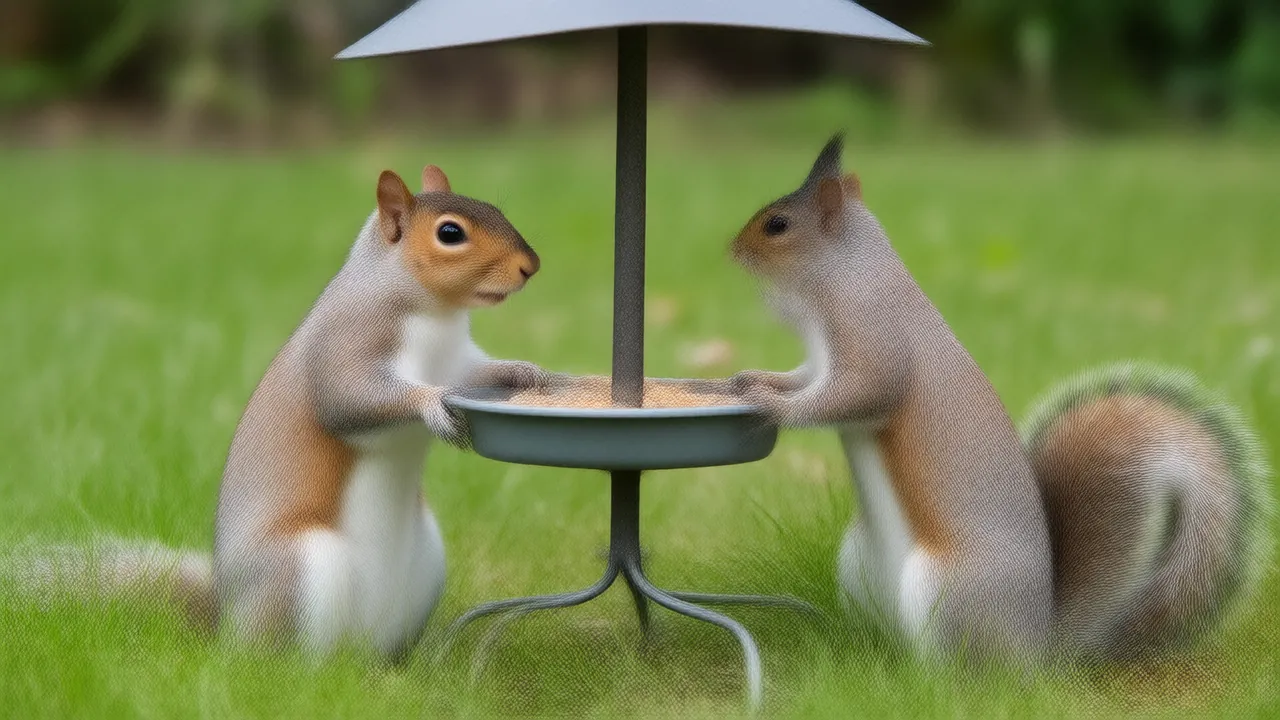
Quick answer
Mount a squirrel baffle on the feeder pole with its lower edge at least 4 feet off the ground, and hang every feeder above it with the feeder bottoms at about 5 feet or higher. Stand the pole 8 to 10 feet from trees, fences, deck rails and roofs, with no branches overhead. The baffle stops climbing; the distance stops jumping.
In this guide
Place a squirrel baffle on the feeder pole with its lower edge at least 4 feet off the ground, hang every feeder above it, and stand the pole where there is 8 to 10 feet of open air to the nearest tree, fence, deck rail or roof. A baffle stops squirrels climbing up; the distance stops them jumping around it. Get either one wrong and the baffle does nothing.
Those numbers are a rule of thumb built around the eastern gray squirrel, the most common feeder raider in the US. A gray squirrel can spring roughly 4 to 5 feet straight up and leap 8 to 10 feet sideways from a raised launch point, and some individuals do better, so add margin where you can.
The setup in words: a picture from the ground up
Imagine standing beside a squirrel-proof feeder pole and looking at it from the ground to the top:
- Ground level. Bare lawn or a mulched bed, with no shrubs, benches, grills or planters within 8 to 10 feet. Anything a squirrel can climb is a launch pad.
- The pole. A smooth metal pole, set straight and firmly in the ground so it does not lean or sway.
- The baffle, lower edge at 4 feet or higher. This is the barrier. Everything a squirrel could reach from the ground sits below it; everything worth eating sits above it.
- The feeders, bottoms at about 5 feet or higher. They hang from hooks or arms above the baffle. No feeder, tray or chain dangles lower than the top of the baffle.
- Open sky above. No branches overhanging the feeders. Squirrels will happily drop from above onto a feeder.
Around that pole, picture a circle roughly 20 feet across with nothing squirrels can climb inside it. That circle is as important as the baffle.
Measure launch distances from the feeder, not from the pole. A feeder on a long extension arm can end up several feet closer to a fence or tree than the pole itself.
Pole baffles vs hanging baffles
Cone baffles
A cone baffle is a wide, flared shield that clamps around the pole below the feeders. A squirrel climbing the pole hits the underside and has nothing to grip. Many are designed to tilt or wobble when a squirrel touches them, which makes them harder to get past. Cone baffles stop squirrels and chipmunks well but are less reliable against raccoons, which are big enough to reach around some of them.
Cylinder baffles
A cylinder baffle, often called a torpedo or stovepipe baffle, is a tube with a closed top that slides over the pole. A typical one is about 2 feet long. Squirrels cannot climb its smooth sides or reach over the top, and its length also defeats raccoons, so it is the better choice anywhere raccoons raid feeders at night. The guide to keeping raccoons out of bird feeders covers the rest of the raccoon problem.
Hanging (dome) baffles
A dome baffle hangs above a feeder, for example one suspended from a tree branch or a wire. A squirrel coming down from above lands on the dome and slides off. For it to work, the dome needs to be wider than the feeder by a comfortable margin, and the feeder should hang close under it so a squirrel on the edge cannot stretch down and grab a port.
A dome only protects against squirrels coming from above. The feeder still needs to hang at least 5 feet off the ground and well out of jumping range sideways, which is hard to achieve on a tree branch. In most yards, a pole with a baffle below the feeders is the more reliable setup.
Where to put a bird feeder so squirrels stay away
The baffle can only stop climbing. Keeping squirrels away also depends on where the whole setup stands:
- Away from trees. Keep 8 to 10 feet from any trunk or branch at the side, and no branches directly above.
- Away from structures. Fences, deck railings, sheds, house walls, gutters and rooflines all count. Squirrels leap from roofs onto feeders with ease.
- Away from low launch points. Shrubs, patio furniture, grills, trash cans and raised garden beds give a squirrel the height it needs to clear a baffle.
- Still near cover for birds. Birds like a shrub or small tree nearby to escape hawks. Aim for cover just beyond jumping distance, around 10 to 12 feet from the feeder, so birds have a short flight to safety but squirrels have no springboard.
In a small yard, that circle of open space may be hard to find. A lawn in the middle of the yard is often the only spot that works, and it is worth moving the feeder there even if the view from the window changes. For the full range of squirrel strategies beyond baffles, see how to keep squirrels off bird feeders.
Common baffle placement mistakes
| Mistake | What the squirrel does | Fix |
|---|---|---|
| Baffle mounted too low | Jumps from the ground straight past it onto the pole above | Raise it so its lower edge is at least 4 feet up |
| Feeder hanging below the baffle | Jumps onto the feeder, skipping the baffle entirely | Hang every feeder above the baffle with its bottom at about 5 feet or higher |
| Pole near a fence, deck or shrub | Leaps sideways onto the feeder or the pole above the baffle | Move the pole to 8 to 10 feet from every launch point |
| Branches overhead | Drops down from above | Move the pole or add a dome baffle over the feeder |
| Baffle clamped rigid or too narrow | Grips the edge and pulls itself over | Let a wobble-style baffle move freely; use a wider cone or a cylinder |
| Deep snow around the pole | Stands on the snowpack and jumps from a higher start | Raise the baffle for winter or clear snow away from the pole |
Two other habits undo good placement. Seed piling up on the ground under the feeder keeps squirrels hanging around the pole and trying, so use a seed tray or rake up spills. And never grease the pole or baffle to make it slippery; grease and petroleum jelly can end up on birds' feathers. The guide on whether Vaseline on a feeder pole is safe explains why.
Installing a pole baffle step by step
- Pick the spot first. Walk a 10-foot circle around it and check for anything a squirrel can climb or leap from, including what is overhead.
- Set the pole straight and solid. A pole that leans or rocks gives squirrels a better angle and tilts the baffle.
- Mount the baffle. Clamp or rest it so its lower edge sits at least 4 feet off the ground. If the ground slopes, measure from the high side.
- Hang the feeders. Keep every feeder, tray and chain above the baffle, with feeder bottoms at about 5 feet or higher.
- Watch for a week. Squirrels test a new setup from every angle. If one gets through, watch where it launches from; that is the thing to move.
If you would rather build than buy, the guide to making a DIY squirrel baffle shows simple designs, and stopping squirrels climbing a feeder pole covers pole options.
If squirrels still get past the baffle
Go through the setup again from the squirrel's point of view. Look for the launch point: a new patio chair, a branch that grew out over the summer, a snowbank, a feeder that slipped lower on its hook. Nearly every baffle failure comes down to one of those.
If you cannot find enough open space, change what you offer instead. Squirrels have little interest in nyjer and are less keen on safflower than on sunflower. Some people also set out a separate corn feeder for squirrels at the far side of the yard, which keeps them busy away from the bird feeders. Whatever you choose, stick to humane deterrents; squirrels are persistent, not pests to be harmed.
Questions people ask
How high should a squirrel baffle be?
Mount a pole baffle so its lower edge is at least 4 feet off the ground, with feeders hanging above it and their bottoms at about 5 feet or higher. Higher is safer if your squirrels are good jumpers.
How far from a tree should a bird feeder pole be to stop squirrels?
About 8 to 10 feet from the nearest tree, fence, deck railing or roof, with no branches overhead. Measure from the feeder itself, not just the pole.
Do hanging squirrel baffles work?
A dome baffle stops squirrels dropping onto a feeder from above, but not squirrels jumping from the ground or the side. It works best when the feeder also hangs high and away from launch points.
Which squirrel baffle is best for raccoons?
A long cylinder baffle, often called a torpedo or stovepipe baffle, mounted on the pole. Raccoons can reach around some cone baffles but cannot climb or reach over a long smooth tube.
Written by the Backyard Birdcam team with AI assistance. Found something we got wrong? Email shop@smarternewsnow.com and we will fix it. How we write our guides.